What Actually Makes a Local Service Business Look Trustworthy Online
Most “trust signals” on a local contractor’s website are decoration. “Licensed and insured” sits in a footer with nothing behind it. A services list is ranked by whatever the owner assumes sounds most impressive. Photos are stock, because getting real ones felt like more work than it was worth.
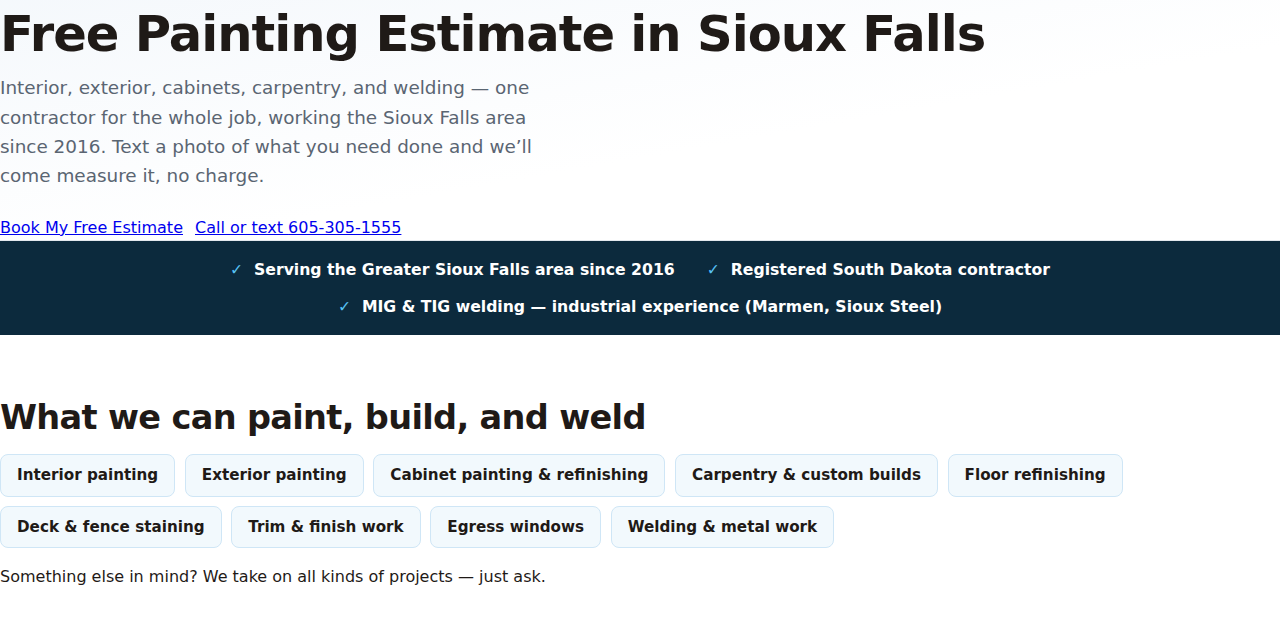
None of that is what actually earns trust, and none of it is what I do. Here’s the real process, built on a real engagement: House Painting Sioux Falls, Nicholas Pilipchuk’s business, named here with his permission.
Rank services by the owner’s real constraints, not a price table
The obvious move is to push whichever service has the highest sticker price. It’s also wrong. Nicholas is a trained welder, but that never came up as a strength worth leading with until I asked directly what kind of work he actually wants more of. He prefers commercial work over residential for a specific reason: fewer clients, longer relationships, easier to build trust with one builder over time than with fifty homeowners one job at a time.
That single answer changed the whole ranking. Not “highest average job value first”. Profitability, how well it fits the specific person doing the work, and how long the relationship lasts, in that order. Two lists, not one price table: who to go after, then which jobs to push once you’re in front of them.
The lesson generalizes past painting: before ranking anything on a services page, get the owner’s own words about what they’re good at and what kind of client relationship they actually want. Rank against that.
Every number on the page has a source, or it doesn’t go on the page
Cost estimates for home-service work are everywhere online, and most of them are copied from somewhere else that copied them from somewhere else. When I build a pricing or service page, every figure gets three things: the number, where it came from, and how confident that source actually is: “fetched directly from the source,” “a search result I couldn’t verify directly, so treat it as directional,” or, when neither of those apply, left out and flagged rather than filled in with something that sounds about right. One service on this engagement got left unresearched on purpose, because the two sites that would have sourced it block automated reads, and a plausible guess is worse than an honest gap.
A trust claim is a real document, or it isn’t a claim
“Licensed and insured” on a contractor’s site should mean someone actually looked at the paperwork. On this engagement it meant reading the real insurance certificate directly (carrier, policy status, and expiry date) before a single word about coverage went on the page. And it means checking again before that claim gets trusted a second time: an insurance policy that’s lapsed since the last time anyone looked quietly turns a true statement into a false one, and nothing catches that except actually re-checking.
The rule is simple and I don’t bend it: a trust claim is real evidence, or it’s omitted. Never asserted because it’s the kind of thing a business like this would probably have.
Use what the owner already has before asking them to produce anything
Owners of small service businesses are busy running the business. Asking them to go dig up job photos, gather invoices, or write testimonials is real work you’re handing back to them. Most of that material already exists somewhere they control (a camera roll, a cloud photo library, an old invoice folder), and the better move is checking there first and bringing back a proposed set for them to approve, rather than adding a homework assignment to their week. Always their call on what actually gets used. Never published without them seeing it first.
The sweep runs before every publish, and it gets re-verified, not just re-run
Every page that goes live gets swept for anything that shouldn’t be there: private details, unverified claims, anything sourced from somewhere it shouldn’t have come from. When I found that an earlier version of that sweep had a real blind spot (it was silently failing to check certain kinds of text on the page), the fix wasn’t just patching the tool and moving on. Everything that had been cleared under the broken version got re-checked from scratch, because a tool that quietly misses things and still reports “clean” is worse than no tool at all.
This is the same process behind every client site I build, not a one-time exercise for this post. If you’re running a local service business and your website’s “trust signals” are decoration rather than evidence, that’s usually the first thing worth fixing, often before the design.